


The Bigger Picture: How a Bug-Catching Kid Changed Everything
Satoshi Tajiri was a kid from suburban Tokyo who loved catching bugs. Most adults would have told him it was a waste of time. Instead, he spent six years trying to convince Nintendo that his idea for a Game Boy game about collecting creatures was worth making. He pitched. They said no. He pitched again. And again. In 1996, Nintendo finally said yes. Pokémon was born in Japan.
A few months later, a young designer named Tsunekazu Ishihara looked at the game and saw something bigger. He created a trading-card version of Pokémon. A small Japanese publisher called Media Factory printed the first packs. Neither man knew they had just started something that would still be growing thirty years later.
Where the Idea of Trading Cards Came From
Three years earlier, in 1993, a mathematician from Pennsylvania named Richard Garfield invented something new for a company called Wizards of the Coast. He called it Magic: The Gathering. It was the first modern trading-card game. Players bought booster packs, hoped for rare cards, built decks, and competed against each other. The thrill of opening a pack, the secondary market where rare cards sold for real money—all of it started with Garfield’s game. Magic sold out its entire first print run in six weeks.
When The Pokémon Company needed an American partner in 1998, they did not go to the big toy companies. They went to Wizards of the Coast—the only company that truly understood how a trading-card game worked. Wizards did more than put Pokémon characters on cardboard. They designed the rarity system, the booster packs, and the tournament structure that Pokémon still uses today.
From Japan to the Florida Keys
Before the official American launch even happened, early fans were already bringing Japanese Pokémon cards into the United States. Many of them were Magic: The Gathering players who understood supply and demand. Kids who could not read a single Japanese word still wanted the cards because they recognized Pikachu.
On January 9, 1999, Wizards of the Coast officially released the English Pokémon Trading Card Game. The first set, called Base Set, sold out everywhere within weeks. Printers could not keep up. A Charizard card that cost about ten dollars in a shop in 1999 later sold for $420,000 in 2022.
The same pattern shows up in other unlikely success stories. Early Bitcoin believers were dismissed as oddballs. They bought in for the idea, not the money, and some became wealthy almost by accident. Pokémon cards followed a similar path: a niche obsession that mainstream culture ignored until it was suddenly everywhere.
What I Saw in Tavernier
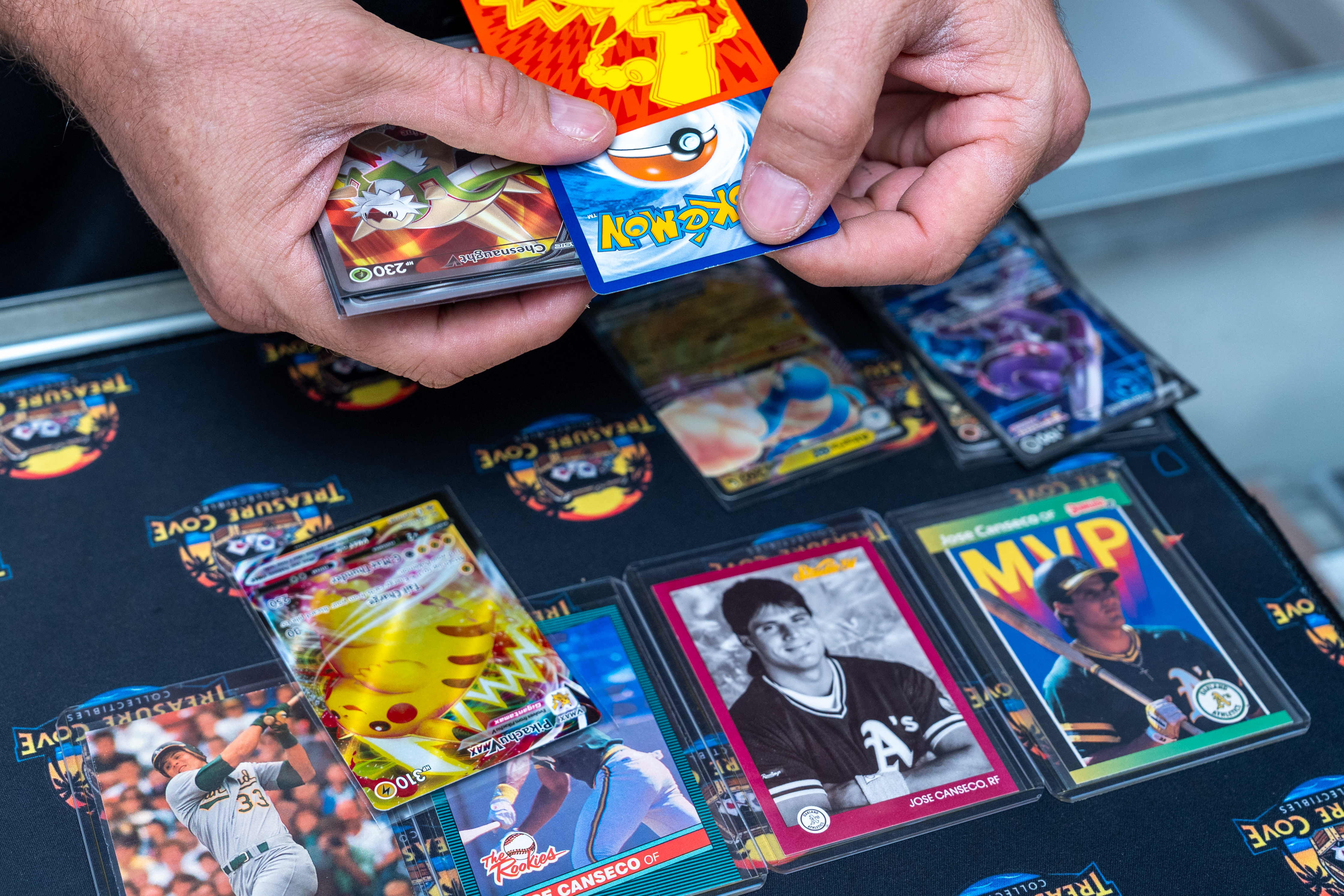
That history felt very close the afternoon I photographed Treasure Cove Collectibles in Tavernier. In the corner of the shop, a group of Magic: The Gathering players—people who call themselves Planeswalkers—were deep in a game. In Magic lore, Planeswalkers are powerful beings who travel between different worlds. That day they were simply two locals: an electrician and an animal-care specialist who also walks dogs. Both were drawn to the same things the rest of the room shared—cards, competition, and community.
Magic The Gathering?
When I pointed out that Magic players and Pokémon collectors often overlap, the shop’s owner, Eric, just smiled. “It happens all the time,” he said. “Magic players love Pokémon. They always have.”
The English Pokémon Trading Card Game is, in many ways, a Wizards of the Coast creation wearing a Pikachu costume. That partnership lasted from 1999 to 2003—four years that turned a Japanese children’s game into a global phenomenon. The DNA is the same: the same structure, the same thrill of the pack, the same human urge to collect, compete, and belong.
The Pivot Points That Changed Everything
Look at the chain of almosts. Tajiri nearly quit after years of rejection. Wizards of the Coast almost passed on the license. Every major step forward happened because someone said yes when they could have said no. What if Tajiri had given up in year three?
That question sits quietly behind the tables at Treasure Cove Collectibles, where locals still open packs, trade cards, and keep the same story going—thirty years after a bug-catching kid refused to stop pitching his idea.

Early Adopters and Accidental Wealth
Here is the parallel nobody wants to admit out loud: Pokémon cards and Bitcoin have almost identical origin stories. Both started as niche obsessions dismissed by mainstream culture. Early adopters got in for love, not money, and accidentally became wealthy. A mythologized founder sits at the center of each story — the genius ahead of their time. Community networks drove explosive growth before institutions caught on. Scarcity in a world of abundance became the core promise for both.
Cardboard and Bitcoin: The Same Unlikely Story
The product Wizards of the Coast launched on January 9, 1999 was called Base Set — the very first English-language Pokémon TCG release. It contained 102 cards, including a holographic Charizard that would one day sell for $420,000. Base Set established the template for every Pokémon set that has followed in the 27 years since: the booster pack format, the rarity tiers, the foil chase cards. All of it lifted directly from Magic: The Gathering’s DNA. Wizards of the Coast didn’t just translate the game — they engineered the entire commercial architecture that turned a Japanese children’s card game into a global financial phenomenon.
The Importers: How It Arrived Before It Was Official
Before the official US launch, there were the importers — mostly hobby shop owners and early Magic: The Gathering players who understood supply and demand better than the suits at corporate. Japanese Pokémon cards were flowing directly from Japan in 1997 and 1998, selling to kids who couldn’t read a single word on the cards but recognized Pikachu.
The Keys Had Its Own Turning Point

Closer to home, in the Florida Keys, treasure has always meant more than gold. For Eric Ward, it began with the work of his father, Glen Ward, during the salvage days.

“My dad had Aquanaut Salvage down here,” Ward said. “He did towing and salvage for years. He owned one of the first dive shops in the Upper Keys at Smuggler’s Cove. That plane that’s actually in the side of Hog Heaven — my dad salvaged that plane.”
A Family Legacy in the Keys
On March 14, 2025, the family legacy took a new form. Ward and his brother Chris opened Treasure Cove Collectibles inside Richard Mangel’s Keys to Embroidery in Key Largo. The shop featured popular card games, trading cards, and sports memorabilia.
By August, they had moved into their own space at 91831 Overseas Highway in Tavernier, next to Keys SmartPhone Repair. Their shop carries the bright circular logo featuring a parrot, a treasure chest, Pikachu, and the familiar Florida Keys branding.

The store’s high-end graded collectibles and sealed product draw the biggest attention. A mint-10 Mickey Mouse Disney card sits in a sealed display case priced at $1,000. Behind Ward’s clean glass card counter, a shelf holds a row of high-value NFL helmets — including an autographed Tom Brady Patriots/Bucs split helmet priced at $2,799.

But for Ward, the real gold is Pokémon.
The Shop Takes Shape
One Saturday afternoon, a lone father walked into the shop — dreadlocks, a visor and sunglasses on his head, subtle tattoos visible. Brian Anthony said he is a local and a regular customer.
“I just like to get them for my kids,” he said as he moved through the space with quiet purpose, carefully selecting cards for his boys.

A separate family — a father and his two sons — browsed the back of the shop. Their faces lit up as they gingerly pulled out a gleaming Shohei Ohtani baseball card and a crisp Patrick Mahomes football card, the glossy surfaces catching the afternoon light. All three huddled over the small treasures in their palms, a shared grin spreading across their faces.
In the background, a single table of Magic: The Gathering players kept a steady rhythm. The two — a local electrician and an animal-care business owner — slapped cards down with quiet focus, completely lost in a miniature world of strategy. Magic players still play the game. Pokémon players, Ward notes, have largely moved on.
The shop was never part of a grand plan. After leaving the restaurant business, Ward went to work with his brother on salvage and hurricane cleanup. During the 2024 season, while they were in St. Petersburg between jobs, he started bidding online on sports helmets simply to kill time.
“I came back with 60 of these helmets and went, ‘I need to sell these things,’” he said. “So me and my brother decided, well, let’s do this.”
The People Who Walk In

They tested the idea first in a tiny space inside the embroidery shop.
“It was like 150 square feet — very small,” he said. “But I had to make sure we could make sales before I signed a lease. We came here in August of 2025 and it’s just been all gas, no brakes since then.”
Collectors arrive from Miami and Key West, but they also show up from much farther away — Sweden, England, and points across the globe. Ward’s brother Chris, owner of Sea Tow from the Islamorada/Tavernier area through the Lower Keys and Key West, brings his own long-running passion for comic books and cards to the partnership. Together, the brothers built a new venture primarily on cardboard. Ward is clear-eyed about what the Pokémon hobby has become.
“It’s one of the only products you can walk into a Target, spend $50 and go sell it in a parking lot for a hundred,” he said. “They’ve produced this product that’s marketed toward kids, but I have 60-year-old men coming in here looking for Pokémon. It’s turned into money. It performs better than the S&P 500 and better than gold and silver.”
Pokémon cards are only printed for two years. Once that window closes, The Pokémon Company never prints them again. The upcoming 30th anniversary issue is expected to add significant value to the scene.
Cardboard as Currency
Ward says three kinds of buyers keep appearing.
“You have that variable where [the customer buys Pokémon cards] because he has kids and his kids like to collect,” he said. “Then you have guys who are just straight chasing the big hits. They’ll open a $200 box and leave all the common cards here and only take the two or three good cards that come out of it. And then you have people who will buy the box and never open it — they’ll just put it in their closet and hold it for 10 to 15 years.”
Ward is direct about the numbers.
“Every person that comes in, I ask if they play the game and it’s just not. It’s changed from playing the game to now they come in treating it like a slot machine or a scratch-off ticket,” he said.

“If you have Pokémon from like 1996, ’98, you can buy a house with this. And not like a house in Ohio — like a house down here.”
“So where are you going next after this?” asks Ward, as the kids nonchalantly walk up to do business with their cards, “bridge jumping” they say with big grins.
The shop door chimed, and a burst of humid air followed two boys inside. Lean and sun-darkened, they were the kind of local kids who live in a permanent state of summer. Their bikes sat in the parking lot, handlebars visible through the store window. The pair brought a kinetic energy that cut through the quiet focus of the Magic players.

They weren’t even 15, but they approached the counter with a stack of cards to sell like they owned the place. The banter between them and Ward was easy and casual, yet strictly business. Ward didn’t give an inch on the price, but he negotiated with a respect that earned their trust.
Every time the door chimed, Ward looked up with a smile to make the newcomer feel like a guest of honor. There was no hard sell here — it felt as if he was simply sharing a passion.
As the afternoon light stretched across the shop, one thing became clear: while the treasure has changed, the Ward family’s gift for finding it remains the same.
Pokémon TCG: 2025 World Championships Deck — “Pult Bomb”
The official deck used by Jose Cruz Galindo-Resendiz at the 2025 World Championships in Anaheim. Built around Dragapult ex with 320 HP. A must-have collector’s piece tied to competitive history.
Pokémon TCG: Scarlet & Violet — Prismatic Evolutions Booster Bundle
Six booster packs featuring the Eevee evolution line in crystal-prismatic style. One of the most sought-after recent sets — strong secondary market value and a fan favourite.
The 30th Anniversary — September 16, 2026
September 16 is the date. For the first time in Pokémon TCG history, every trainer on the planet gets the same packs on the same day — a fully coordinated global release. But local stock will move fast. History tells us exactly what to expect.
The 25th Anniversary launched in 2021. The Pokémon Center website crashed within minutes. Target shelves were cleared before stores officially opened — not by fans, but by resellers with multiple carts. Sealed Elite Trainer Boxes retailing at $49.99 flipped on eBay for $150–$200 the same day. Within six months, some sealed product had tripled in value.
The 30th will be bigger. It’s the first simultaneous global release in Pokémon TCG history. A brand-new card type debuts — Futuristic Rare — that collectors haven’t seen before. Demand will outpace supply on day one.
The Pre-Order Strategy
The single smartest move is locking in a pre-order at retail price before September 16. The pattern is consistent: early buyers at retail come out ahead. Anniversary sets don’t sit on shelves.
Can’t make it in person? Use the official Pokémon store locator at pokemon.com to find the nearest authorized retailer — and call ahead. Anniversary sets don’t sit on shelves.
Professional grading — having an expert certify and encapsulate a card — has added another layer to the market. A raw Charizard and a PSA 10 Charizard are not the same product. Grading turned condition into currency, and the hobby hasn’t looked back.
Several forces keep driving Pokémon prices upward. According to a recent CNBC report, Millennials who grew up with the game now have real money to spend — and nostalgia is a powerful driver. Rare cards are treated like tradable assets. Scarcity of high-grade sealed product keeps prices climbing. Constant media and social hype add fresh fuel. So does the 30th anniversary itself.
Where To Buy — Ranked for Release Day Success
Major Product Retail Prices
Here is MSRP pricing for ALL of the 30th Celebration products. Follow live alerts at @PokeTCGAlerts on X (Twitter).
| Product | Retail Price |
|---|---|
| Elite Trainer Box (ETB) | $49.99 |
| Ultra-Premium Collection (UPC) | $179.99 |
| Poster Collection | $14.99 |
| Tech Sticker Collection | $14.99 |
| Pokémon ex Box | $21.99 |
| Knock Out Collection | $9.99 |
| 2-Pack Blister | $9.99 |
| Day & Night Mini Tins | $9.99 |
| Binder Collection | $31.99 |
| Booster Bundle | $26.94 |
| Espeon ex and Umbreon ex Battle Decks | $19.99 |
| Ditto Premium Collection | $39.99 |
| Mewtwo and Mew Figure Collections | $29.99 |
| Pokémon ex Tin | $21.99 |
Treasure Cove Collectibles — Best for Florida Keys Locals
91831 Overseas Hwy, Tavernier (MM 91.5). The closest shop, run by people who actually love the hobby. Eric Ward is already preparing for the launch. Local game stores often receive pre-order allocation — meaning your copy may be held for you before the shelves even open. Call ahead or stop in to ask about reserving yours. No shipping anxiety, no refresh wars — just walk in and pick it up. Visit Treasure Cove Collectibles →
Amazon (Official Pokémon Store) — Best Online
Pre-orders open early and lock in the retail price — even if the market spikes after launch, you pay what you paid when you ordered. Amazon Prime delivers on release day for millions of customers. Stock is typically the largest of any single retailer, and if sealed product sells through, Marketplace sellers step in as a backup. Pre-order on Amazon →
Pokémon Center (pokemoncenter.com) — Official But Risky on Drop Day
The first-party source, but it crashed hard during the 25th Anniversary and will be under even more pressure this time. Worth trying, but never rely on it as your only plan. Visit Pokémon Center →
Target, Walmart & GameStop — Confirmed to Carry Launch Product, But Risky
Major retailers will have first-wave stock on Sept. 16, but shelves get cleared fast — often by resellers before casual buyers arrive. Not a dependable strategy for a high-demand anniversary set without lining up early.
TCGPlayer — Best for Singles After the Drop
Not ideal for sealed product on release day, but once the set is out, TCGPlayer is the go-to marketplace for hunting specific cards at competitive prices.
The Keys Connection
September 16, 2026 (Wednesday) for the main Wave 1 products of Pokémon TCG: 30th Celebration. This is the first simultaneous worldwide TCG release.
Additional waves follow: October 2 (Mini Tins, Booster Bundle, Binder Collection), October 30 (Battle Decks), and November 6 (Ultra-Premium Collections, Figure Collections, Ditto Premium Collection, etc.).
The email arrived on a Thursday morning, from the editor of the Florida Keys Free Press. The story was running. That quietly electric feeling — of something small becoming real — is exactly what this place does to you.


Leave a Reply