
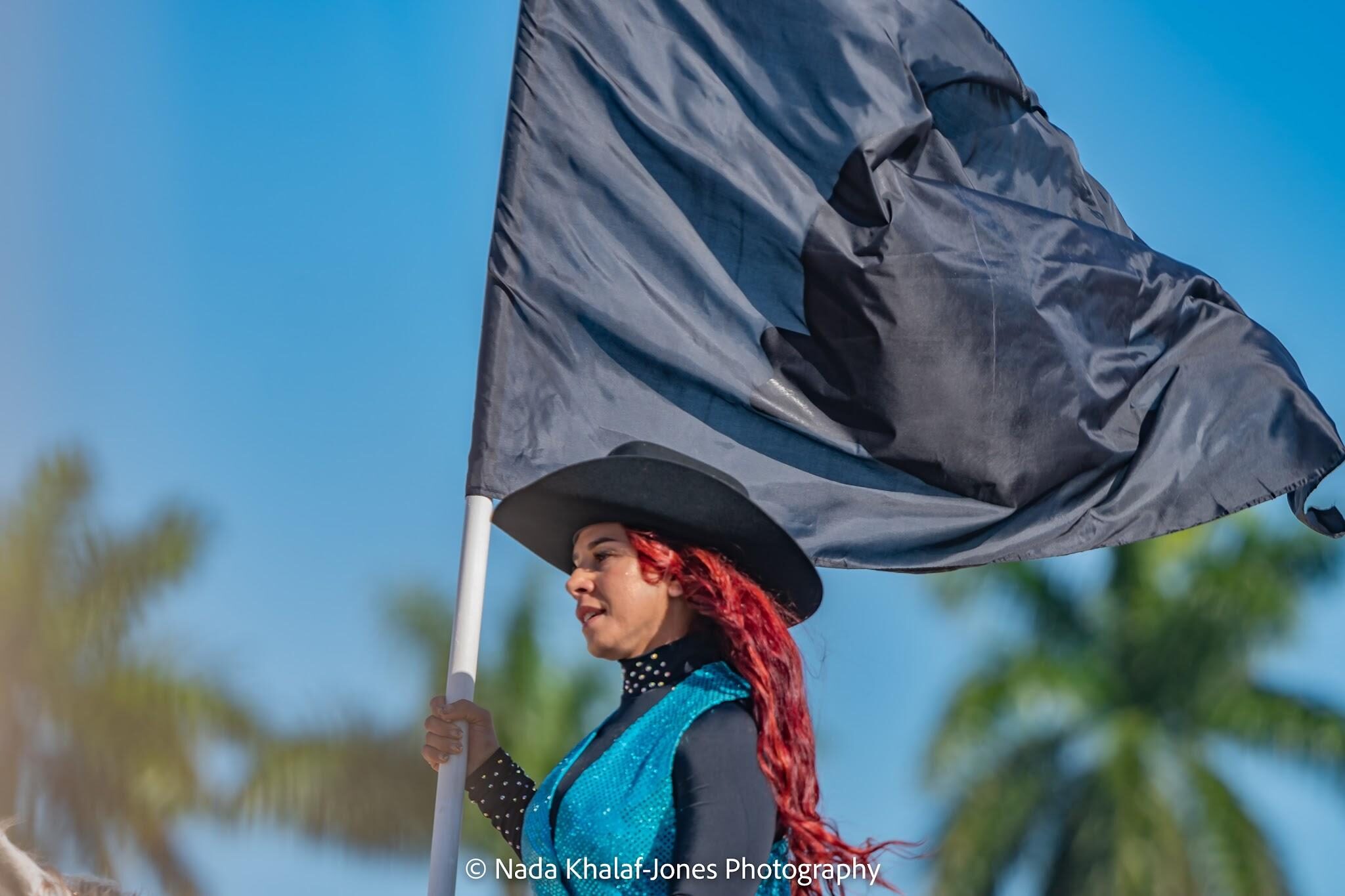
Crystal Schnebly has served as a combat medic, worked in law enforcement, and rides in rodeos across South Florida. The strongest lessons of her life, she says, came from the barn.
By Nada Khalaf-Jones
A Familiar Place in the Saddle
On a bright afternoon in Homestead, Crystal Schnebly sits tall on a white-and-brown spotted horse, a black flag snapping in the wind above her red hair. The crowd at the Redland rodeo is loud, the arena dusty, the sun sharp. She looks completely at home.
She has looked that way for years.
Crystal rides every season. She shows up even on the days she does not feel like it. That simple act—showing up—has become the through-line of a life that has moved from the Army to law enforcement to the arena and back again.
“Horses have taught me that you really can’t fake being present,” she says. “If I walk into the barn distracted, frustrated, or thinking about ten other things, my horses usually know before I even realize it myself.”
She bought her first horse at sixteen. Excitement carried her at first. Then came the harder truth: progress with a horse is almost never a straight line.
Lessons From Her First Horse
“You could have a great day and feel like you had made a breakthrough, and then the next day it felt like you were starting all over again,” she remembers. “That horse taught me that frustration doesn’t move you forward. Consistency does. Sometimes not quitting simply means coming back the next day with a better attitude and being willing to try again.”
The same principle has followed her through every chapter.
In the Army she learned structure, responsibility, and how to function under pressure as a combat medic. Law enforcement demanded those same qualities, then added new ones: communication, adaptability, and the ability to connect with people in community policing, K9 work, mounted patrol, and public information roles. Horses, she says, have always been the reset button.
From the Army to Law Enforcement
“Military and police work can involve situations where things happen very quickly and there are a lot of responsibilities competing for your attention. With a horse, I have to come back into the moment. The horse doesn’t know or care what kind of day I had. It needs me to be calm, clear, and present.”
That ability to reset has become one of her most practical tools. So has the habit of focusing on small improvements instead of demanding perfection.
Small Improvements Over Perfection
“In the barn, sometimes success is one better step, one calmer response, or getting something a little better than you did yesterday,” she says. “A teenager can do the same thing this school year. Instead of looking at an entire semester and getting overwhelmed, ask yourself, ‘What is one thing I can do better today?’ Small improvements add up.”
Crystal is deliberate when she talks about toughness. Early on she believed toughness meant pushing through everything and never showing weakness. Horses corrected that idea.
Redefining Toughness
“Horses showed me that being tough isn’t the same thing as being forceful. Real toughness also means patience, self-control, knowing when to back off, and being willing to change your approach when something isn’t working. That lesson has followed me into almost every other part of my life.”
She is equally clear about career change. Many young people freeze because they fear choosing the “wrong” path. Crystal’s own path is a living counter-argument: animals, horses, the military, law enforcement, community policing, K9, mounted patrol, public information.
On Career Change and Changing Direction
“Changing direction does not mean you failed,” she says. “You don’t have to have your entire life figured out at 16, 18, or even 25. Pick a direction, work hard, learn everything you can from it, and understand that you are allowed to grow into something different.”
When doubt arrives—and it has arrived—she uses a simple rule: do not make permanent decisions based on temporary frustration.
Don’t Make Permanent Decisions in Temporary Moments
“A bad moment is not the same thing as a bad future,” she says. “With horses, one bad ride doesn’t define the horse or the rider. You regroup, figure out what went wrong, and try again. The same thing applies to a bad grade, losing a friend, not making a team, or questioning yourself. Don’t let one chapter convince you that you already know how the entire story ends.”
What continues to drive her is the chance to make a difference—whether through law enforcement, working with animals, mentoring someone younger, or simply showing that there are many ways to build a meaningful life.
Keep Showing Up
Her closing advice is quiet and direct:
“Resilience doesn’t mean life never knocks you down. It means you develop the confidence to know that you can get back up. You are going to have setbacks. You are going to make mistakes. There will be times when someone else seems further ahead than you, and there will be moments when you question yourself. Keep showing up. Keep learning. Stay willing to change direction when you need to. Your circumstances today do not determine where you can end up tomorrow.
And if horses have taught me anything, it is that some of the strongest partnerships, biggest accomplishments, and best versions of ourselves are built one small step at a time.”
On the arena floor in Homestead, the black flag still snaps in the wind. Crystal rides on, present, steady, one step at a time.
After the South Dade News Leader piece went live, Crystal texted:
“You are amazing this brought tears to my eyes.”
“I’ve never had anyone do something like this for me.”
“Ty so much. I will never forget this ever.”
“Wow. See what happens when you do stories about people who love horses!!”


Leave a Reply